

How to Dismiss an Employee in the Netherlands
menu_book HR S.O.S. Guide

How to Dismiss an Employee in the Netherlands

Step-by-step guide to lawful employee dismissal under Dutch employment law

schedule 14 min read · arrow_back Part of HR S.O.S.
How to Dismiss an Employee in the Netherlands
schedule
Notice Period 1–4 months
euro
Transition Payment ~1/3 month/year
assignment
Routes 3 legal paths
gavel
Grounds Required 8 statutory

Understanding Your Options

If you need to dismiss an employee in the Netherlands, the first thing to understand is that at-will termination does not exist. Every dismissal must follow one of three legal routes, and every route requires proper documentation and, in most cases, a valid statutory ground.

The route you choose depends on the reason for dismissal, the urgency of the situation, and whether the employee is willing to cooperate.

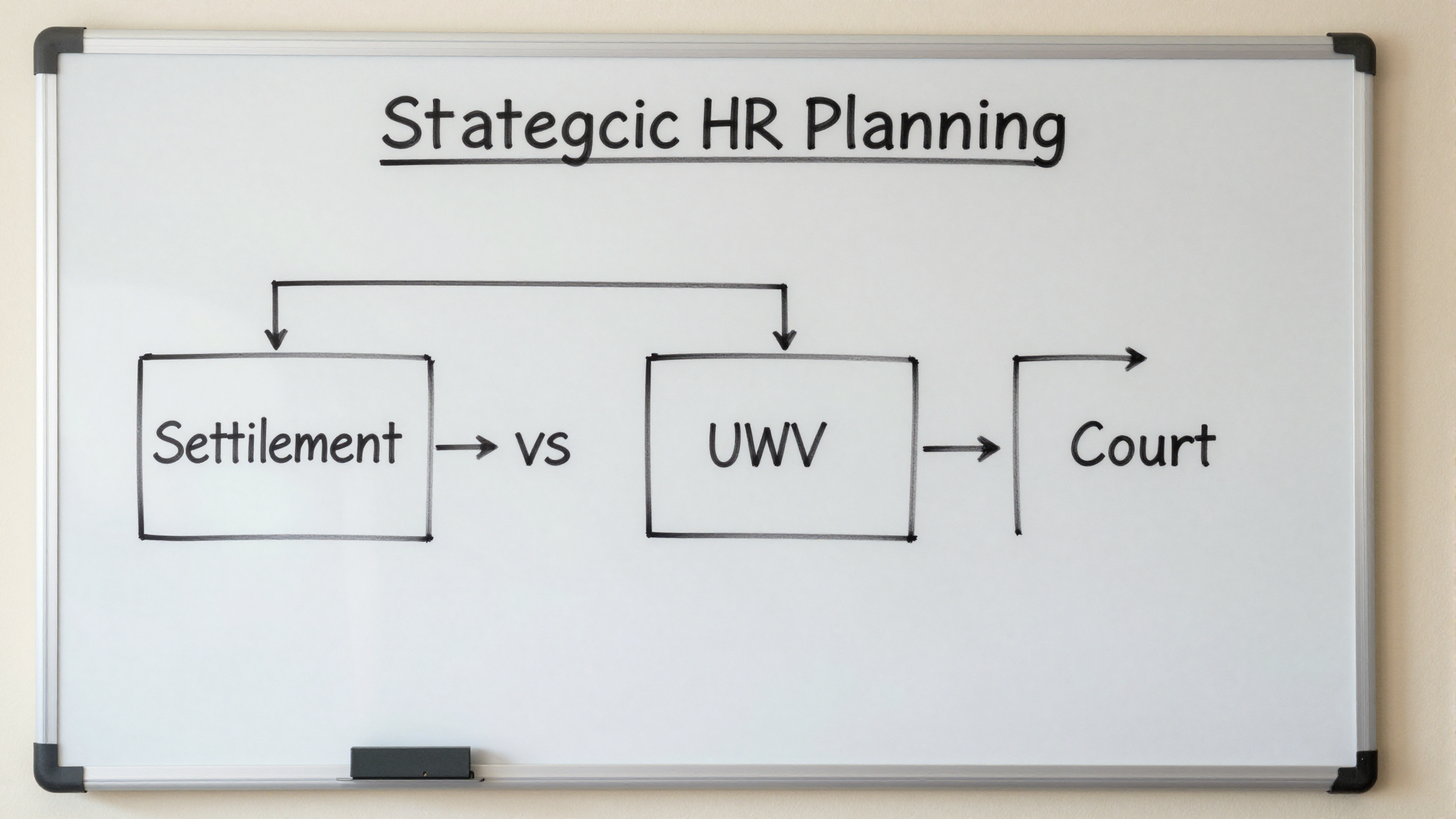
Route 1: Settlement Agreement (Vaststellingsovereenkomst)

The most common and preferred route — approximately 85% of Dutch terminations use a settlement agreement:

  • Process: Employer proposes termination with a package; employee negotiates terms
  • Timeline: Can be completed in days to weeks
  • Key terms: Termination date, severance (at minimum transition payment), notice period compensation, final salary, references, legal cost contribution
  • Cooling-off: Employee has 14 calendar days to revoke a signed agreement — this right cannot be waived
  • Unemployment: If structured correctly, the employee retains the right to unemployment benefits (WW)

Route 2: UWV Dismissal Permit

Used for two specific grounds: economic dismissal (redundancy) and long-term illness (after 2 years):

  • Redundancy: Must demonstrate structural job loss due to financial, organizational, or technological reasons. Reflection principle applies for selection.
  • Long-term illness: Employee must have been sick for 104+ weeks, reintegration must be exhausted, and there must be no prospect of recovery within 26 weeks.
  • Processing: UWV typically decides within 4–6 weeks. Employee can appeal to the court.

Route 3: Court Dissolution (Kantonrechter)

Used for all other grounds — performance issues, misconduct, disrupted relationships:

  • Process: Employer files a petition with the cantonal court. Oral hearing typically within 4–6 weeks.
  • Documentation: The employer must prove the dismissal ground is 'fully substantiated' — partial grounds may justify cumulation (ground i) with additional compensation up to 150% of transition payment.
  • Court decision: The judge can grant or deny dissolution. If granted, sets the termination date and confirms the transition payment amount.

Calculating the Transition Payment

Every dismissed employee (except summary dismissal for urgent cause) is entitled to a transition payment:

  • Formula: 1/3 of gross monthly salary per year of service
  • Part years: Pro-rated for partial years (including months and days)
  • Day one: The right arises from the first day of employment — even probation terminations trigger transition payment
  • Maximum: €94,000 (2026) or one annual salary if higher
  • Additional compensation: Courts can award additional 'fair compensation' (billijke vergoeding) if the employer acted seriously culpably

How It Works

Step-by-Step Process

01

Assess Situation & Ground

Identify the applicable dismissal ground and determine the optimal route.

02

Build Documentation

Compile all supporting evidence — performance files, financial data, medical reports, warning letters.

03

Execute Procedure

Draft settlement proposal, file UWV application, or submit court petition.

04

Post-Termination

Process final salary, transition payment, and administrative closeout.

How to Dismiss an Employee in the Netherlands — key insight
Why It Matters

Key Insights for Your Business

trending_up
93% of companies report smoother operations with proper HR setup
shield
€25K+ average savings from avoiding common compliance penalties
schedule
4–6 weeks to fully operational with expert guidance vs. 3+ months DIY

"Having the right HR infrastructure in place from day one saved us months of fixing problems later. It's the foundation everything else builds on."

— HR Director, International Company in NL
How to Dismiss an Employee in the Netherlands — results
Important Considerations

What to Watch Out For

high

Sick Employee Dismissal Ban

You cannot dismiss an employee during the first 2 years of illness. Attempting to do so will be reversed by the court.

high

Missing 14-Day Cooling-Off Notice

Settlement agreements must explicitly mention the 14-day revocation right. Without this notice, the cooling-off period extends to 21 days.

medium

Inadequate Performance File

Dysfunction dismissals (ground d) require documented evidence of coaching, warnings, and improvement plans spanning several months.

Common Questions

Frequently Asked Questions

Can I fire someone immediately for serious misconduct?

Summary dismissal (ontslag op staande voet) is possible but extremely risky. It must happen immediately when the facts are discovered, the reason must be 'urgent cause,' and the employee must be heard first. Courts reverse a significant percentage of summary dismissals.

How much does a dismissal cost?

At minimum: transition payment (1/3 month per year of service) + notice period salary. In practice, settlement agreements often include 1–3 months additional severance, legal cost contribution (€750–€1,500), and positive reference.

What if the employee is pregnant?

Pregnant employees have special dismissal protection from the start of pregnancy until 6 weeks after returning from maternity leave. Dismissal during this period is only possible in exceptional circumstances unrelated to the pregnancy.

Can I reduce the team without individual dismissals?

Not easily. Even in restructuring, each affected employee must receive individual notice, transition payment, and the reflection principle must be applied for selection within interchangeable function groups.

Need Help?

Ready to get started with HR S.O.S.?

Book a free 30-minute consultation. We'll assess your situation and propose a clear path forward — no commitment required.