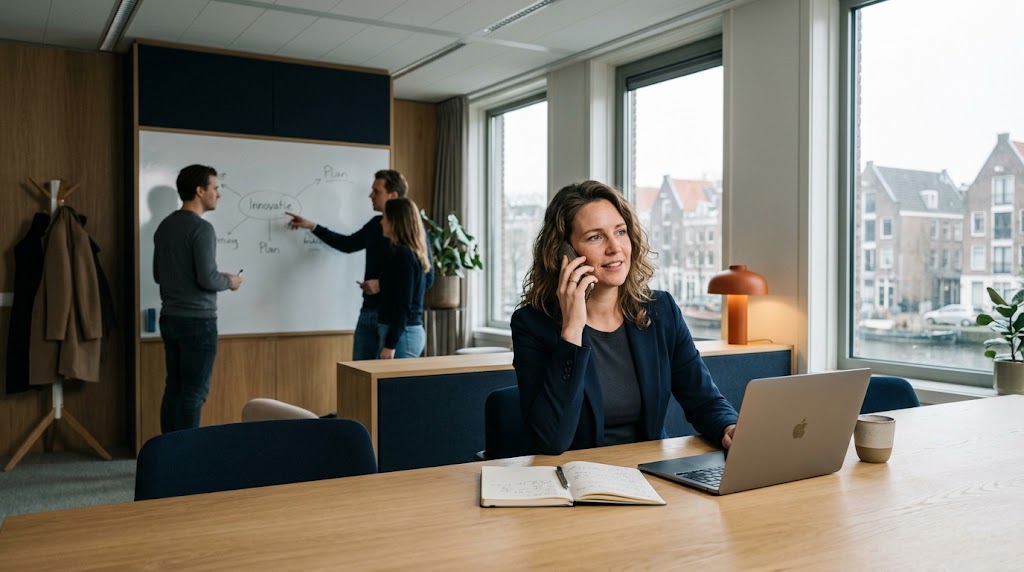

The sudden global transition to remote operations structurally rewired the expectations of the modern workforce. While some global business hubs are witnessing a slow, forced march back to the traditional five-day office week, the Netherlands is charting a fundamentally different course.
In the Dutch labor market, hybrid working is not considered a temporary pandemic-era compromise or an exclusive perk offered only by progressive tech startups. It has been codified into law, integrated into corporate infrastructure, and permanently woven into the national work culture.
For international companies scaling their operations in Europe, understanding the reality of hybrid work in the Netherlands is non-negotiable. If your expansion strategy relies on mandating 100% physical office attendance without a robust localized justification, you will find yourself completely unable to attract or retain top-tier talent.
This comprehensive guide breaks down the legal framework regarding remote work in the Netherlands, the logistical challenges of cross-border hybrid models, and how to proactively design a resilient hybrid work policy.
The Legal Foundation: The Flexible Working Act
Dutch employment law actively champions the employee’s ability to balance their professional and personal lives. This ethos is legally anchored by the Flexible Working Act (Wet flexibel werken).
The Right to Request
Under this act, any employee who has completed their initial six months of employment possesses the formal statutory right to request a change to their working hours, their working times, and crucially, their physical place of work. An employee can formally petition to transition from a full five-day office week to a hybrid model (e.g., three days remote, two days in the office).
The Employer’s Obligation to Respond
As an employer, you cannot simply dismiss this request out of hand because “it is not company policy.” You must enter into a formal consultation process with the employee.
Legally, you are only allowed to reject the request if you can demonstrate “compelling business or service interests” (zwaarwegende bedrijfs- of dienstbelangen). A valid compelling interest might be that the employee operates physical machinery that cannot be moved, or that their absence completely disrupts a strict rostering schedule for customer-facing support.
However, arguing that “we prefer to see people at their desks” is not a legally defensible position under Dutch law. If you reject a request without adequate justification, an employee can challenge the decision in court. Ensuring your global leadership understands this dynamic is a critical priority, as outlined when exploring the broad leading HR trends in 2025.
Designing the Physical Office vs. Remote Balance
If the legal mandate establishes hybrid work as the baseline, the strategic challenge becomes designing an ecosystem where both environments thrive.
Repurposing the Office
The traditional corporate headquarters—acres of isolated cubicles and silent open-plan desks—is dead in the Netherlands. In a hybrid model, the physical office serves a radically different purpose. It is no longer the default location for focused, individual deep work; the home office handles that far more efficiently.
Instead, the office must be redesigned as a collaborative “clubhouse.” Progressive Dutch companies are stripping out individual desks in favor of massive collaborative brainstorming spaces, state-of-the-art hybrid meeting rooms that seamlessly integrate remote dial-ins, and comfortable social areas designed to foster the importance of company cultures. You go to the office to connect, innovate, and align; you go home to execute.
The Home Office Allowance
In the Netherlands, if you allow or mandate an employee to work from home, you are legally obligated to ensure they have a safe and ergonomically sound workspace, in accordance with the Dutch Working Conditions Act (Arbowet).
Furthermore, to compensate employees for the utilities and depreciation associated with working from home, the Dutch government facilitates a specific untaxed work-from-home allowance (thuiswerkvergoeding). Currently hovering around a few euros per working day, this allowance must be accurately calculated and processed through your payroll system based on the actual percentage of days the employee worked remotely.
The Trap: Cross-Border Remote Work
The most dangerous pitfall in the hybrid working landscape occurs when “working remotely” crosses an international border.
The “Work From Anywhere” Illusion
It is incredibly common for expats living in the Netherlands to ask to work remotely from their home country (e.g., Spain, Italy, or the US) for extended periods over the summer. While this sounds like an amazing benefit, it triggers a catastrophic cascade of compliance issues for the employer.
If an employee works remotely from a foreign country for an extended period, they may inadvertently cross complex tax residency thresholds. Suddenly, your Dutch entity might be legally obligated to withhold Spanish or Italian payroll taxes, or worse, your employee’s presence might establish a “Permanent Establishment” for corporate tax purposes in that foreign country.
Your hybrid work policy must explicitly, legally define the geographical boundaries of “remote work.” A policy that allows an employee to work from a café in Utrecht is completely different from a policy that allows them to work from a beach in Bali for three months. Attempting to untangle these accidental tax liabilities is notoriously expensive, and is a frequent trigger point for requiring comprehensive HR outsourcing support to fix.
Building a Thriving Hybrid Culture
Ultimately, successfully deploying hybrid work requires a fundamental shift in management philosophy.
Managing Output, Not Presence
The traditional managerial instinct is to monitor presence: “If I can see them sitting at their desk, they are working.” In a hybrid model, this mindset fails completely.
Managers must be retrained to manage purely on output and Key Performance Indicators (KPIs). If a developer delivers flawless code precisely on deadline, it is entirely irrelevant if they wrote it at 10:00 AM in the Amsterdam office or at 9:00 PM at their kitchen table.
This requires implementing sophisticated digital project management tools, committing to radical transparency, and actively cultivating trust. If a manager feels the need to strictly monitor their remote employees with aggressive tracking software, they are destroying the psychological safety required for high performance and severely damaging your employer branding.
Conclusion
Hybrid working in the Netherlands is a mature, legally protected, and highly optimized ecosystem. It demands that international employers treat their workforce with trust, invest in dual-infrastructure (both digital and physical), and maintain intense vigilance regarding cross-border tax compliance.
If you attempt to forcibly export an inflexible, office-first mandate into the Dutch market, you will immediately alienate the very top tier of local talent.
If you are struggling to build a compliant, attractive, and operationally rigorous hybrid framework for your expanding Dutch operations, you do not have to architect it alone.
Contact our team today to learn how we successfully design and implement secure hybrid working policies that attract top-tier talent while keeping your business totally compliant.